


Screening a new tenant? Get a free rental application form — — download the PDF free, no card needed.
Is there a limit on rental application fees?
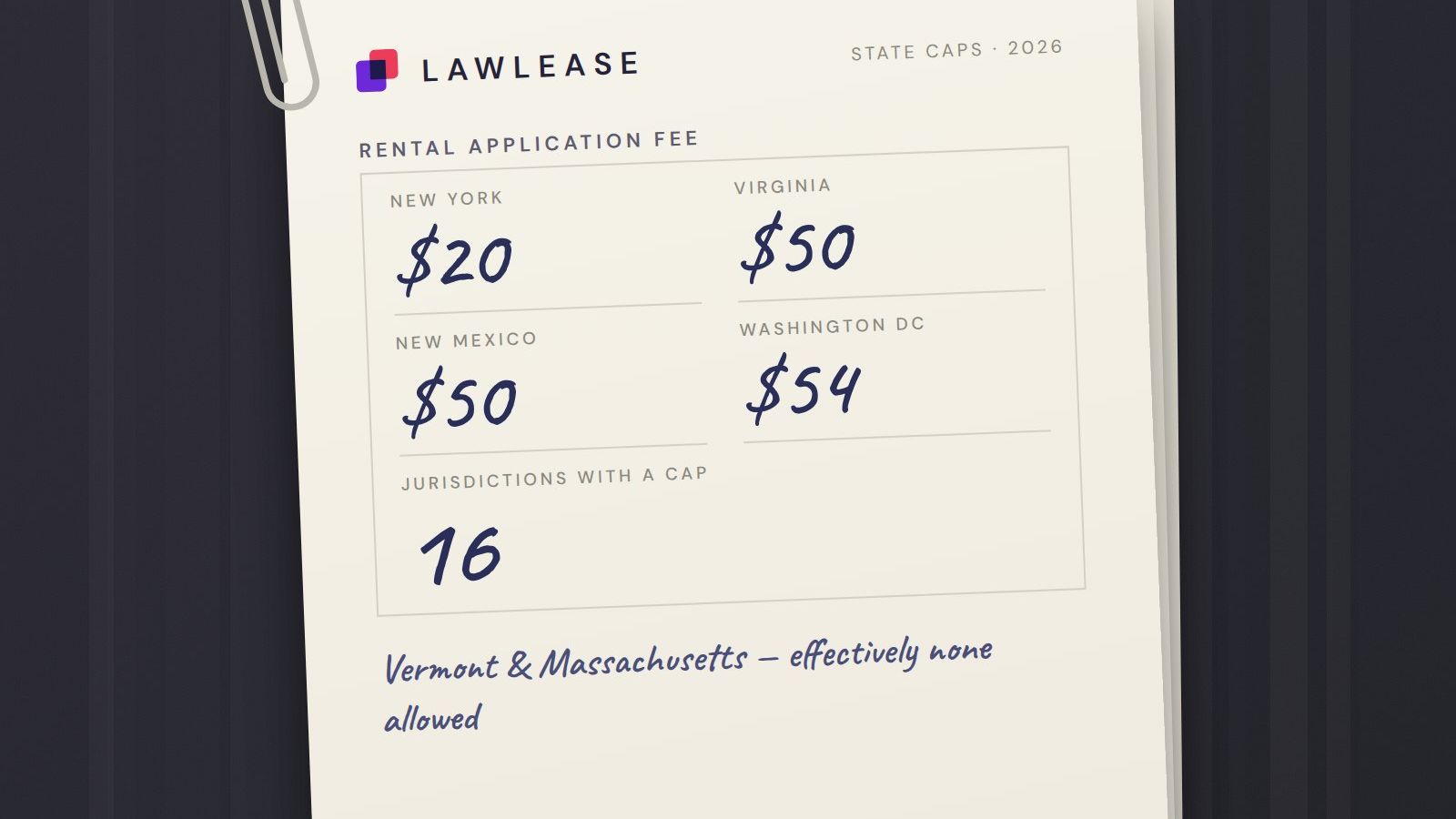
In 16 jurisdictions, yes. The caps run from $20 to $68.96, and two states — Vermont and Massachusetts — go further and bar the fee in practice. In the remaining states there is no statutory number, but a fee well above the real cost of screening invites a consumer-protection complaint and is hard to defend if challenged.
Rental application fee limits by state
| State | Fee cap | Refund rule | Statute |
|---|---|---|---|
| California | CPI-indexed (up to actual screening costs) | Unused amount must be returned | Cal. Civ. Code § 1950.6 |
| District of Columbia | $54 (CPI-adjusted) | Refund within 14 days if screening is not conducted | D.C. Code § 42-3505.10 |
| Massachusetts | Effectively prohibited | See statute | Mass. Gen. Laws ch. 186, § 15B |
| New York | $20 | Cannot exceed actual screening cost | N.Y. Real Prop. Law § 238-a |
| Virginia | $50, plus actual third-party screening costs | See statute | Va. Code § 55.1-1203 |
| Vermont | Application fee prohibited | Not applicable | 9 V.S.A. § 4456a |
Showing jurisdictions with verified application-fee rules. Other jurisdictions are omitted pending attorney review.
Column spec: State · Fee cap (dollar figure, "Effectively prohibited", or "No statutory cap") · Refund rule (when an unused fee must be returned) · Statute (rendered as a link). "No statutory cap" is a finding, not a blank.
What can an application fee legally cover?
The fee is meant to cover the cost of processing the application — a credit report, a background check, and the landlord's time verifying income and references. In capped states, those costs have to fit inside the cap rather than being added on top of it. A separate "credit check fee" charged alongside a capped application fee is the most common way landlords exceed the limit without realising.
The fee is not a holding deposit, and it should not be treated as one. Money taken to take a unit off the market is a different payment, and in several states it is regulated differently.
Does a landlord have to refund an application fee?
Sometimes. For example, Oregon requires a refund within 30 days if the landlord fills the unit before screening the applicant, or has not ordered screening before the applicant withdraws in writing. The common thread in states that regulate refunds: if the landlord never ran the screening, or rented the unit to someone else before considering the application, the fee should come back.
The safest practice everywhere is the same — take application fees only when a unit is genuinely available, process applications in the order received, and return the fee if screening never happened.
Can a landlord charge every applicant, or only the one they choose?
Charging every adult applicant is generally lawful where fees are permitted, provided the same fee applies to everyone. Charging different applicants different amounts for the same unit is a fair-housing problem, not a pricing decision. Set one fee per property, apply it to every adult applicant, and write it into the listing before the first enquiry.
Do tenants have to be told why they were denied?
Yes, where the denial is based in whole or in part on a credit or background report. Under the federal Fair Credit Reporting Act, the landlord must give the applicant an adverse action notice naming the reporting agency, stating that the agency did not make the decision, and explaining the applicant's right to a free copy of the report and to dispute it. This applies in every state, capped or not.
Your application should already say all of this.
LawLease's rental application includes residence and employment history, income, references, and a signed background-check authorisation — with the fee rules for your state built in. Download the free PDF, no card needed.
What about reusable tenant screening reports?
In California, an applicant who provides a reusable tenant screening report cannot be charged an application screening fee when the landlord elects to accept that report. California Civil Code § 1950.1 sets out that rule. The aim is to stop an applicant paying for the same credit check repeatedly during one apartment search.
If you operate in one of those states, the application form should say whether you accept reusable reports — and if you do, that the fee will not be charged.
How to set an application fee that holds up
Before you charge an application fee
- Check your state's cap in the table above. If there is one, the whole screening cost has to fit inside it.
- Charge only when the unit is available and you intend to consider the application.
- Apply one fee to every adult applicant for the same property.
- Disclose the fee before taking it — in the listing and on the application itself.
- Keep a receipt of what the screening actually cost you, especially in uncapped states.
- Refund the fee if you never ran the screening.
- Send an adverse action notice whenever a report influenced a denial.
Frequently asked questions
They are different payments. The application fee covers screening; a holding deposit reserves the unit. Some states regulate holding deposits separately, and none allow a holding deposit to be disguised as an application fee to get around a cap.
It depends entirely on the state. In New York the cap is $20, so no. In an uncapped state it may be lawful, but only if it reasonably reflects screening costs. Check the table above for the exact figure.
Generally yes, if the screening was already run — the cost has been incurred. If the applicant withdraws before any screening happens, returning the fee is the safer course, and in some states it is required.
A co-signer is screened like an applicant, so charging the same fee is common practice where fees are allowed. In capped states the cap applies per person screened. State the co-signer fee on the application so it is not a surprise.
Free Rental Application Form
Residence, employment, income and references, with a signed background-check authorisation built in.
Rental application forms by state
- Alabama
- Alaska
- Arizona
- Arkansas
- California
- Colorado
- Connecticut
- Delaware
- Washington DC
- Florida
- Georgia
- Hawaii
- Idaho
- Illinois
- Indiana
- Iowa
- Kansas
- Kentucky
- Louisiana
- Maine
- Maryland
- Massachusetts
- Michigan
- Minnesota
- Mississippi
- Missouri
- Montana
- Nebraska
- Nevada
- New Hampshire
- New Jersey
- New Mexico
- New York
- North Carolina
- North Dakota
- Ohio
- Oklahoma
- Oregon
- Pennsylvania
- Rhode Island
- South Carolina
- South Dakota
- Tennessee
- Texas
- Utah
- Vermont
- Virginia
- Washington
- West Virginia
- Wisconsin
- Wyoming
LawLease is not a law firm and does not provide legal advice. This article summarises application fee rules in general terms and is not advice about your situation. Consult a licensed attorney in your state before relying on any of it.
Tags
Share article