


Building a lease right now? Create a free Florida lease agreement — download the PDF free, no card needed.
What disclosures are required in a Florida lease?
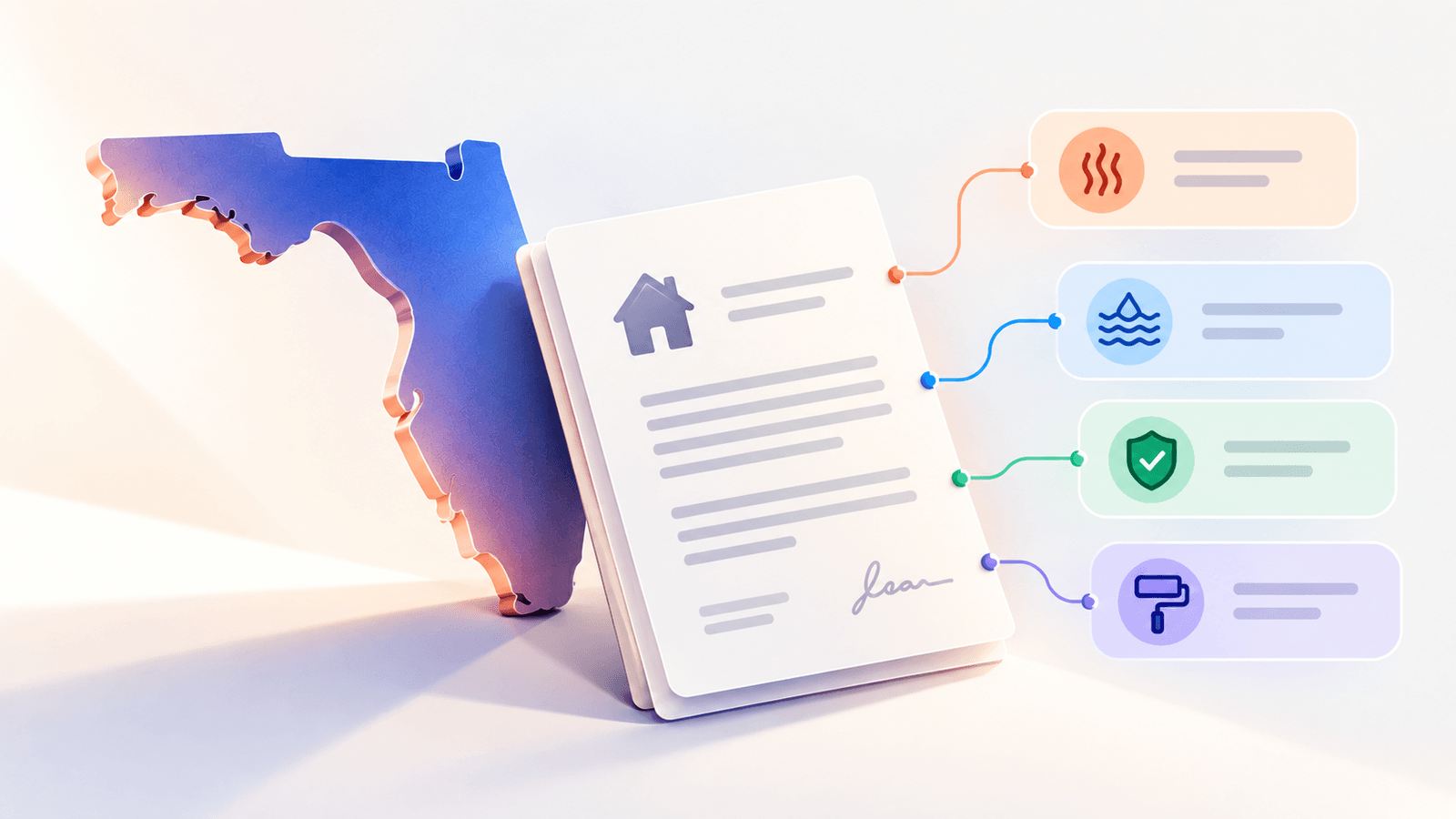
Florida requires four disclosures in a residential lease, plus the federal lead-based paint disclosure for properties built before 1978. Each is listed below with when it applies, the statute behind it, and what leaving it out costs.
- Radon gas notice — every residential rental, no exceptions (Fla. Stat. § 404.056(5)). If omitted: the lease fails a requirement that applies to every Florida building, and the fix is a one-paragraph notice with prescribed wording.
- Flood disclosure — leases of one year or longer, on a separate document (Fla. Stat. § 83.512). If omitted: a tenant who suffers substantial flood loss may be able to terminate the lease early.
- Security deposit notice — within 30 days of receiving a deposit or advance rent; landlords with fewer than five units are exempt (Fla. Stat. § 83.49). If omitted: it undermines the landlord’s footing in any later deposit dispute.
- Landlord / agent identity — the name and address of the landlord or the agent authorized to receive notices, at or before the start of the tenancy (Fla. Stat. § 83.50). If omitted: the tenant has no proper address for notices, which complicates every notice that follows.
- Lead-based paint (federal) — any home built before 1978 (42 U.S.C. § 4852d). If omitted: federal civil penalties, and potential liability for damages.
Does Florida require a radon disclosure?
Yes — in every residential lease in the state (Fla. Stat. § 404.056(5)). Florida is unusual here: the radon notice is not limited to particular counties, building types or construction dates, and it applies whether or not the property has ever been tested. The required text is prescribed by statute, so it should be reproduced word for word rather than paraphrased.
Does Florida require a flood disclosure in a lease?
Yes, as of October 1, 2025 (Fla. Stat. § 83.512). For a residential lease of one year or longer, the landlord must disclose — on a separate document, at or before signing — whether they know of flood damage to the property and whether they have filed flood-damage claims. Florida joined ten other states requiring landlords to disclose flood risk or flood history to residential tenants.
Because the requirement is recent, leases downloaded or copied before October 2025 almost certainly omit it — including templates still circulating on free-form sites.
What must a Florida landlord disclose about the security deposit?
Within 30 days of receiving a security deposit or advance rent, the landlord must tell the tenant in writing how it is held (Fla. Stat. § 83.49). The notice covers where the deposit is held, whether it is in an interest-bearing account, and the rate of interest if any. Landlords who rent fewer than five units are exempt from this notice.
It is a written notice with a statutory deadline attached, not simply a clause in the lease, and missing the deadline is one of the more common Florida landlord errors. The rules on returning the deposit are separate — see security deposit rules for landlords.
When is the federal lead paint disclosure required?
For any residential property built before 1978, in all fifty states (42 U.S.C. § 4852d). The landlord must give the tenant the EPA-approved pamphlet, disclose any known lead-based paint or hazards, and attach a signed lead-based paint disclosure to the lease. Federal penalties for omission are substantial and independent of anything in Florida law.
The trigger is the construction year, so it should be asked for rather than left for the landlord to remember. A Florida lease built with LawLease attaches the disclosure automatically when the build year is before 1978.
Florida lease disclosure checklist
Disclosure
Applies to
Radon gas notice
Flood disclosure
Security deposit notice
Landlord / agent identity
Lead-based paint
Florida does not require bedbug, mold or general fire-sprinkler disclosures for ordinary residential leases, so a Florida lease does not need to be padded with notices the state does not ask for.
Your lease should already say all of this.
LawLease applies Florida's required disclosures, deposit rules and notice periods automatically, and cites the statute behind each one. Download the finished PDF free.
Watermark removal, e-signature with audit trail, amendments and addenda are on Pro from $10.99/mo billed annually.
What happens if a disclosure is missing?
The consequence depends on which one. Omitting the federal lead paint disclosure carries federal civil penalties and can expose the landlord to damages if a child is harmed. Omitting a state disclosure more often affects the landlord’s position in a dispute — for example, a landlord who skips the flood disclosure may face a tenant terminating the lease after a flood (Fla. Stat. § 83.512).
The pattern worth understanding: a missing disclosure rarely voids the whole lease, but it reliably weakens the landlord’s position in any dispute that follows, and it turns a clean eviction or deposit claim into a contested one.
Do these rules apply to a room rental or a short-term let?
Not always. Florida’s residential landlord-tenant act has a defined scope, and transient occupancy in a hotel, motel or other public lodging establishment — which includes most vacation rentals — is excluded from it (Fla. Stat. § 83.42). A room rental inside an owner-occupied house is a further case again.
The safe approach is to identify which category the arrangement falls into before choosing a template — a room rental agreement and a short-term rental agreement are different documents for a reason. Starting with a residential lease and hoping it fits is how disclosures get missed.
Frequently asked questions
Only if it runs longer than one year (Fla. Stat. § 725.01); a shorter oral tenancy can be valid. But the disclosures above still apply either way, and several of them are impossible to satisfy without a document — a practical reason to put every Florida tenancy in writing regardless.
Mostly, yes. The disclosure requirements attach to the residential tenancy, not the length of the term, so a month-to-month Florida lease needs the radon, deposit, identity and lead paint disclosures. The flood disclosure is the exception — it applies to leases of one year or longer.
It depends whether the arrangement falls within Florida’s residential landlord-tenant act. Where it does, the disclosures apply in full. Where it does not, the federal lead paint requirement can still apply independently, since it is tied to the property rather than the tenancy type.
The landlord is responsible for compliance regardless of who prepared the lease. A property management agreement can allocate the cost between them, but it does not shift the statutory obligation away from the owner.
Free Florida Residential Lease Agreement
State-specific clauses, required disclosures included, generated in about six minutes.
LawLease is not a law firm and does not provide legal advice. This article summarizes Florida disclosure requirements in general terms and is not advice about your situation. Consult a licensed Florida attorney before relying on any of it.
Tags
Share article